The Driver
September, 1954 · Bristol, TN
There is something magical about the last Saturday of summer. Twelve-year-old Michael understood that, and so it didn’t seem strange when a tunnel of gold-flecked light appeared between the willow trees that lined both sides of the narrow road he was walking. At that moment he wouldn’t have been surprised if Sir Lancelot himself appeared on horseback at the crest of the hill, where the gnarled limbs of two trees arched across the road in a tangled canopy of green and brown.
He lived two miles from the basketball court where he’d spent the day with friends and could have taken the shortcut across the creek and been home in half an hour. Instead, he took the long way, along the creek bank, and then across an open field before hopping a fence onto the winding country road.
He had yet to resign himself to the notion that on Monday he would be back in a classroom instead of playing ball, hiking the leafy trails of the Appalachian foothills, or even backing his grandmother’s car down the driveway. Learning to work a column shift and clutch had been his favorite accomplishment that summer. It even inspired him to get serious about saving for the day when he could climb into his very own car and hit the open road.
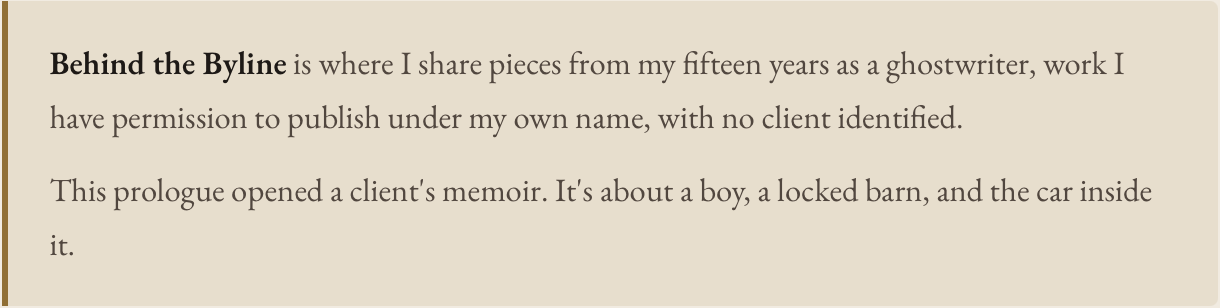
There was a break in the tree line at the top of the hill. A weathered barn sat a few yards from the road, and fifty feet up the slope was a newly painted, two-story house. It had a wrap-around porch and a manicured garden spilling over with late summer vegetables and flowers. Enzo, the owner of the property, had moved to Bristol from Italy a year earlier. Michael met him when he and his father took their car to Enzo’s automotive garage for some transmission work. They were surprised when they stepped into Enzo’s shop; where other garages were dark and grimy, with old car parts, rusting cans, and greasy tools strewn around the floor, Enzo’s shop was well-lit and sparkling clean, from the polished concrete floor to the perfectly organized tool chests and varnished work surfaces. Wrenches were hung in order of size on white pegboard, the iron vises mounted on workbenches were painted bright, cherry red, and dozens of parts bins were neatly labeled and stacked in a tall cabinet. Enzo himself came out to meet them in clean, pressed mechanic’s overalls. Michael had never seen anything like the shop, or its mechanic. The experience impressed him; it was the first time in his life that he connected the idea of being a mechanic with being a true professional.
Enzo happened to be looking for summer help at his home outside of town. Michael jumped at the opportunity, and soon was clearing brush, weeding gardens, and hauling wheelbarrows of pea-gravel to make walking paths around the property. In addition to his pay (25¢ per hour), Enzo’s wife sent him home with a wicker basket filled with ripe plum tomatoes, summer squash, green beans, and strawberries at the end of each workday. That was enough motivation for him to take the long way home that afternoon, but there was another reason, too: something mysterious was going on in the old barn, something the Italian guarded like a pallet of gold bullion in Fort Knox.
He turned from the road and walked up the long asphalt drive towards the barn. He had never been inside; the yard tools he used were kept in a separate garden shed and he would normally have passed the barn and gone right up to the house, but he noticed that the barn door was slid about 1/3 of the way open. Well, if it was open…
It only took a quick glance to see that this was no ordinary barn. The sealed concrete floor was recently poured, and the hay loft had been torn out. The windows were new, and a half dozen or so industrial light fixtures bathed the space in a clean, warm light. A work bench that was so new he could smell sawdust shavings extended the length of the left wall. A small lathe sat in the center of the work surface, and a few feet down the surface was a drill press. Along the back wall was a row of tall cabinets, while three massive, multi-drawered toolboxes on wheels lined the right wall.
A 12” x 6” exposed wooden beam ran high above, from the front of the barn to the back. A flag hung from the right side of the beam, about halfway down its length. It was a tricolor, with three equally sized vertical stripes of green, white, and red. On the left side of the beam were five flags. The first was solid green, the next was yellow, then black, red, and at the end of the row was a black-and-white checkerboard flag.
What was this place, he wondered. It was as clean and well-organized as a hospital room. He had guessed right: Enzo was up to something mysterious.
What confirmed that suspicion was not so much the lights, or the concrete pad, or even the flags. Instead, it was whatever was sitting in the middle of the floor, shrouded under a thick canvas drop cloth that was as new and clean as everything else in the barn. It was far too small to be a tractor, he thought. Couldn’t be a pickup, either. In fact, it was even smaller than his grandmother’s 1951 Chevrolet Bel Air.
He stepped closer to the covered object, and rested his hand lightly on the front end, which was only a few feet off the ground. It did not sit high enough to be any kind of car he knew of. It felt like metal. Would it be OK if he lifted the tarp just enough to get a quick look, he asked himself? After all, the barn door was open, and there weren’t any “No Trespassing” signs or anything like that.
He thought better of sneaking a peek and turned to leave. As soon as he passed through the open door, though, his curiosity roared to life, and he found himself turning around and walking back to the mysterious object.
“I’ll just lift one corner,” he thought. “That can’t do any harm.”
He gently tugged at the lower left front of the canvas tarp, pulled it back about two feet, and let out a gasp. It was a car, all right, but the small corner he had exposed was like nothing he had ever seen or even dreamed about. A lustrous glow shone from the perfectly smooth, pearl-white surface. One small headlight was visible. It was rimmed in chrome, and beneath it was what looked like a moustache line that swooped under the light.
He decided to pull the canvas back just a little more. Now he could see a black, egg-crate style front grill, and a dark black tire with chromed spokes. He gathered his courage and pulled the tarp back a few more feet. The effect of the pearl paint was even more impressive now. He noticed there was no front bumper, and then his attention was drawn to a rectangular badge on the hood. It was yellow, with stripes of green, white, and red on the top, just like the flag hanging above his head. In the middle of the badge a black stallion reared up on his hind legs, and under the horse were the letters SF.
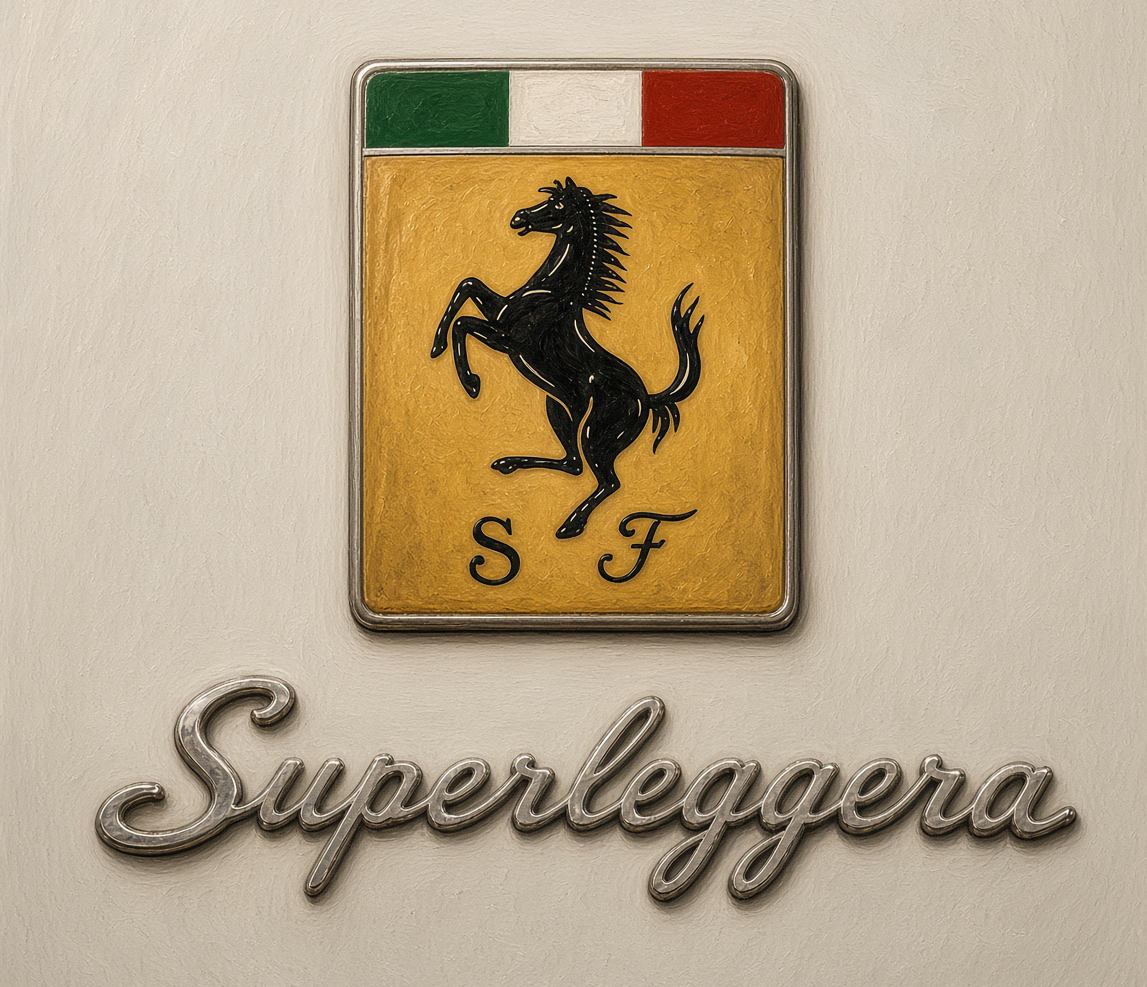
The tarp was now pulled back about half the length of the hood. That’s when he noticed the small, chromed, cursive-type word Superleggera affixed along the left hood, running parallel to the hood line. Was that the brand name of the car, like a Ford or a Buick? Superleggera? He tried to pronounce the word out loud: “Sew-par-leggy-ra.”
“Superleggera,” corrected a deep, accented voice behind him.
Michael whipped around. Enzo had come up silently, like a soldier sneaking up on a sentry. No, Michael thought, more like a cop catching a burglar. Enzo was wearing his mechanic’s overalls. He had a fresh cup of coffee in one hand, and a piece of toast in the other. He set them on the work bench, and Michael steeled himself for the tongue-lashing, and firing, that was about to come.
The Italian ran a hand through his silver hair. Then, to Michael’s astonishment, he smiled, stepped closer to the car and, in one sweeping gesture, pulled the tarp completely off. He set the cover on a table and turned to the boy.
“Well?” he finally asked.
For a moment, Michael could not speak. His eyes devoured the exposed car the way a starving man surveys a roasted turkey. He noticed that the small doors had no outside handles, and that the convertible had not been designed for any kind of hard or rag top. Instead of a single windshield, there were two small windscreens that looked designed to fold flat if the driver or passenger wanted to feel the wind. There were two royal blue cloth seats, and the large metal steering wheel was on the right side of the car, not the left as in American automobiles. The combined effect of the sleek lines, rounded edges, opalescent paint, and absence of superfluous chrome or metal exterior trim gave him the sense that he was standing in front of a great work of art, not just a car.

His own words made him feel a little silly, but when he looked at Enzo the man simply gave a slow, serious nod of agreement.
“This is a Ferrari 166 S,” said Enzo. “Some call it the barchetta, which means little boat.”
“And Superleggera?” What does that mean?”
Enzo was pleased at the boy’s proper pronunciation. “It describes the process by which the Italian manufacturer, Touring of Milan, affixed aluminum alloy panels directly to the tubular space frame.”
“Aluminum,” said Michael, almost to himself.
“That helps to make the car both light and rigid,” said Enzo. “That’s important for handling, especially on winding roads.” The mechanic reached under the long narrow hood, pulled the release, and raised it up. Michael had never seen an engine like it; sleek, compact, and amazingly clean. Then he saw something that confused him.
“Three carburetors?” he asked. “Is that right?”
Enzo smiled. “You know what a carburetor does?”
“Sure, it blends air and fuel so combustion can take place.”
“The 166’s three carburetors increase output from 110 to 140 horsepower, at 6,000 RPM,” said the mechanic. “And the 1.5-liter V12 engine was designed by my friends at Gioacchino Colombo just for this car.”
Michael looked at the mechanic with newfound respect. “Your friends built this car?”
Enzo nodded. “The car was designed by my associate Carlo Anderloni. Only 39 were ever built. This is one of them.”
Michael was at a loss for words. “How…where…why…?” He couldn’t hold the next question back: “What the heck is it doing here in Bristol?”
The Italian chuckled. “I was chief mechanic at Ferrari from 1947, when we built the first Ferrari-badged car, until last year, when I met the American woman who would become my wife. We made the decision to live here, near her family. I left my country, but I brought my profession, and my car, with me.”
Now Michael walked slowly around the small car. He wanted to touch it, to climb inside, and most of all, he wanted to drive it. He had never wanted to do anything so badly in his life.
Enzo watched the boy without saying a word. It had been the same for him in 1929 when his father took him to Scuderia Ferrari in Modena, where he worked as a mechanic. The sights, and smells, and sounds of racing automobiles being custom prepared for their owners introduced young Enzo to his life’s purpose.
The mechanic stepped over to a bench, opened a drawer, and took out a set of keys. Then he removed two sets of racing goggles from their pegs on the wall. Michael was still rooted to his spot and didn’t notice what Enzo was doing. The mechanic waited a minute and then gave a quick whistle. The boy raised his head just in time to see Enzo toss a pair of goggles his way. He caught them in mid-flight, and a mile-wide grin spread across his face as Enzo closed the hood. “She is beautiful here in the shop,” Enzo said as he reached inside the driver’s door and popped it open. “But she was built for the open road. What do you say we let her stretch her legs?”
Michael opened the passenger door and slid into the bucket seat. His heart was racing. He held the goggles up, and asked, “Goggles? Are we going to go that fast?”
Enzo smiled. He started the engine, and as the deep thrum of the V12 engine came to life he said, “Oh, yes. That fast.” Then he backed the Ferrari out onto the drive and turned the car around. He waved to his wife, who had come out onto the porch when she heard the car start. Michael waved to her, too.
Enzo slipped the car down the drive, and out onto the road. He stopped for a moment, letting the engine idle. “Ready?” he asked.
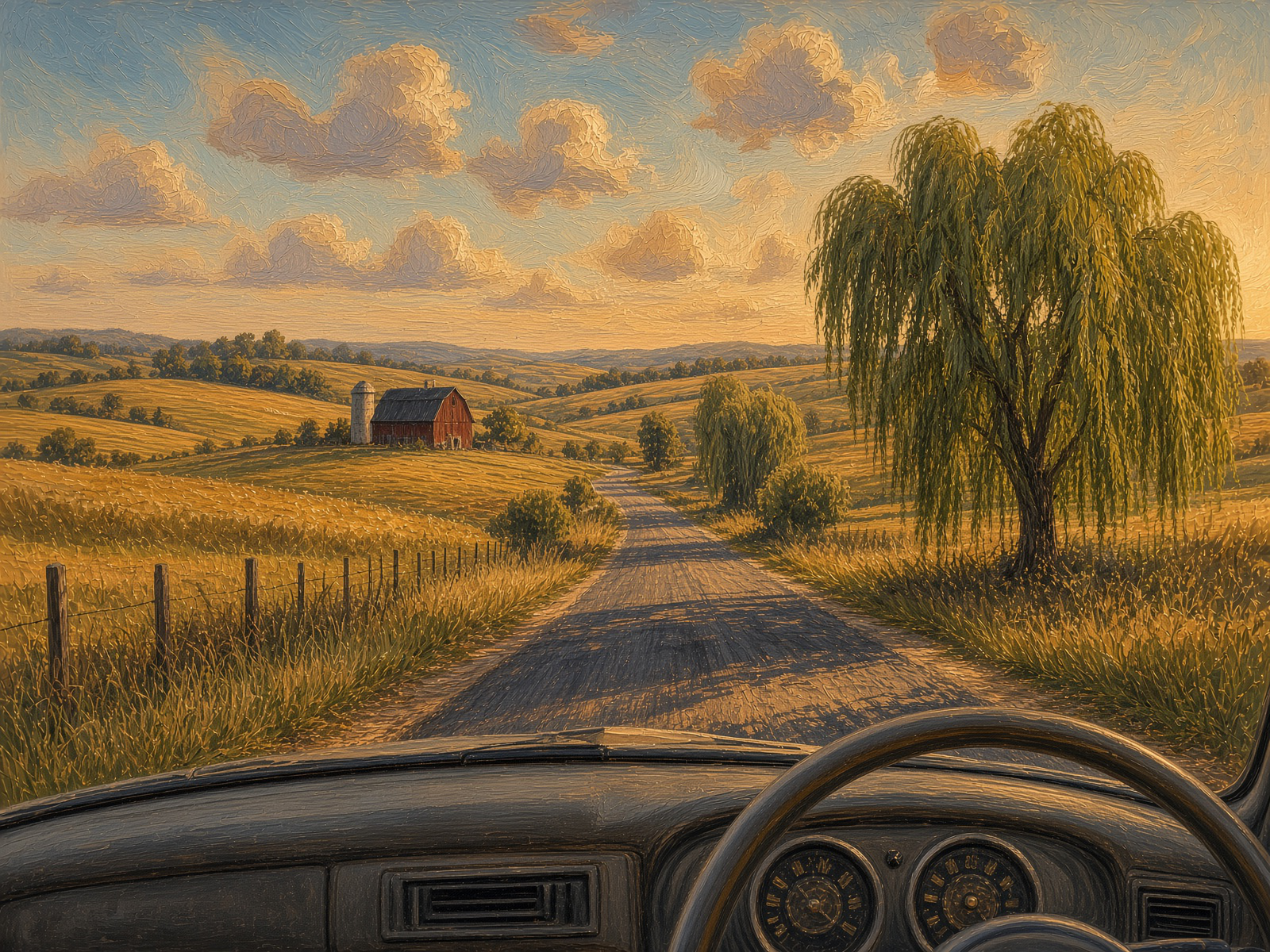
Michael looked out over the hood. Under the golden sun the sky was blue and cloudless, and the road before them swept for miles past fields and forests, and along creeks and pasturelands. In his heart, he knew they would have it to themselves today. A soft breeze rustled the leaves of the towering black walnut tree next to the barn.
“Ready,” came his answer.
Enzo shifted from neutral into first gear and released the clutch. The car leapt forward, and the first great adventure in Michael’s life began.
-end-